
Ultimate Crypto Glossary: Decode the Language of Crypto Enthusiasts!

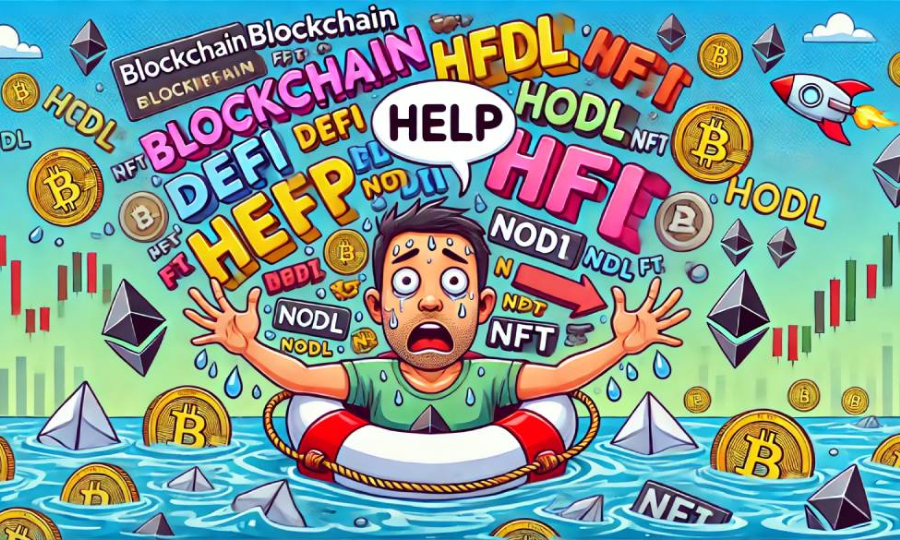
Basic Crypto Glossary by Themes:
You just landed in the crypto world and you hear stuff like:
"I'm long on BTC before the bull run, but the whales are dumping, smells like a rug pull!"
If that makes you feel like people are speaking an alien language, don't worry. Here's the ultimate crypto glossary so you can finally understand what it's all about!
The Basics: Understanding Essential Words
- Bitcoin (BTC): The first crypto created in 2009 by Satoshi Nakamoto. It's kind of the "daddy" of all cryptos. 👑
- Ethereum (ETH): The second most well-known crypto, which allows smart contracts to run (see below).
- Altcoin: All cryptos that aren't Bitcoin or Ethereum, (Solana, Cardano, ChainLink, etc).
- Blockchain: A technology that records all transactions securely and in a decentralized way. Basically, an indestructible ledger. 📖🔗
- Wallet: A digital wallet to store your crypto. There are two types:
- Hot wallet: Connected to the Internet (e.g.: MetaMask, Trust Wallet). 🌐
- Cold wallet: Offline and therefore more secure (e.g.: Ledger, Trezor). ❄️
- Exchange: Platform where you can buy, sell and trade crypto (Binance, Coinbase, Kraken…).
Crypto Trading: Conquering the Moon (or the Abyss)
- 🚀To the Moon: Expression used when a crypto is climbing very hard.
- 📉Dump: When a crypto's price drops brutally.
- 📈Pump: When the price skyrockets. (Sometimes due to manipulation).
- 🐋Whale: A big investor who holds tons of crypto and can influence the market by buying or selling all at once.
- 👀HODL: "Hold On for Dear Life" = Keep your crypto despite market drops, hoping they'll explode someday.
- 🔪Rug Pull: Scam where crypto project creators disappear with investors' money.
- 💎Diamond Hands: Those who never sell, even in a storm. (Respect ✊)
- 👐Paper Hands: Those who panic and sell as soon as it drops a bit. 😅
- 💰Market Cap: The total value of a crypto in circulation. Kind of like a company's size on the stock market.
- 🛑Stop Loss: An automatic order to sell your crypto if the price drops too much, to avoid a bloodbath.
The World of Mining and DeFi
- ⛏Mining: The process to validate transactions on a blockchain and earn crypto in exchange. (Spoiler: It consumes a lot of energy.)
- 🔥Proof of Work (PoW): Mechanism used by Bitcoin where computers must solve complex calculations to secure the network.
- ⚡Proof of Stake (PoS): Alternative to mining where you lock (stake) your crypto to secure the network and earn rewards.
- 💸Yield Farming: Investing your crypto in DeFi protocols to generate passive income.
- 💰Liquidity Pool: A reserve of crypto that users lend to help with exchanges on DeFi platforms.
- 🔀DEX (Decentralized Exchange): Crypto exchange platform without intermediary (Uniswap, PancakeSwap…).
- 🏦CEX (Centralized Exchange): Centralized platform that manages exchanges (Binance, Coinbase…).
NFTs and the Metaverse: The New Digital Wild West
- 🖼NFT (Non-Fungible Token): A unique digital asset (image, video, music…) stored on a blockchain. Some are sold for millions of dollars.
- 🎮Play-to-Earn (P2E): Video games where you can earn crypto or NFTs by playing.
- 🌐Metaverse: Virtual universe where you can buy digital land, work, play… or burn your crypto on a virtual island.
- 🦧Bored Ape Yacht Club (BAYC): An ultra popular NFT collection representing bored apes.
Security & Scams: Don't Get Fooled
- 🔑Seed Phrase: Series of secret words that allows you to recover your crypto wallet. NEVER share it!
- 👿Phishing: Theft attempt where someone tries to make you enter your seed phrase on a fake site.
- 🎭Scam: Scam of any kind (fake cryptos, fake giveaways, fake Elon Musk on Twitter…).
- 🔒Ledger/Trezor: Ultra secure physical wallets to store your crypto offline.
Memes & Crypto Community Expressions
- 🔊Wen Lambo?: Ironic question from investors wanting to know when they'll get rich and be able to buy a Lamborghini.
- 🚀FOMO (Fear Of Missing Out): Fear of missing an opportunity. The reason why many people buy at the peak before a crash.
- 💀Rekt: Completely ruined, financially destroyed after a bad trade.
- 🎣FUD (Fear, Uncertainty, Doubt): Spreading negative news to make crypto prices drop.
- 💪Degen: Short for "degenerate", someone who takes huge risks on crypto.
Complete Alphabetical Crypto Glossary:
Click on a letter to jump directly to the corresponding section.
A
Altcoin: Any cryptocurrency other than Bitcoin. Examples: Ethereum, Litecoin, Ripple.
Airdrop: Free distribution of tokens or cryptocurrencies to the community, often to promote a project or launch.
ASIC (Application-Specific Integrated Circuit): A type of mining hardware specially designed to mine cryptocurrencies, like Bitcoin.
B
Bitcoin (BTC): The first cryptocurrency, created by Satoshi Nakamoto in 2009. It's a decentralized payment system.
Blockchain: The underlying technology of cryptocurrencies. It's a distributed and immutable ledger of all transactions.
Block: A block is a unit in the blockchain that contains a list of transactions. Each block is linked to the previous one.
Burning: Process of destroying tokens or cryptocurrencies to reduce supply and potentially increase the value of other units.
C
Cryptocurrency: Digital currency based on blockchain technology. Examples: Bitcoin, Ethereum, Ripple, Litecoin.
Cold Wallet: An offline cryptocurrency wallet, offering maximum security against hacking.
Consensus: Method used to validate transactions on a blockchain. Example: Proof of Work (PoW), Proof of Stake (PoS).
Chainlink: A project aiming to connect smart contracts with real-world data, providing a decentralized infrastructure for oracles.
D
DeFi (Decentralized Finance): Decentralized finance that enables financial services (loans, exchanges, etc.) without going through traditional institutions like banks.
DAO (Decentralized Autonomous Organization): A decentralized autonomous organization that operates without centralized management, often governed by smart contracts.
Dapp (Decentralized Application): Application that runs on a blockchain or decentralized network, offering more security and transparency than traditional applications.
Dusting Attack: An attack where small amounts of cryptocurrency (dust) are sent to addresses in order to collect personal information.
E
Ethereum (ETH): A blockchain platform that allows creating smart contracts and DApps. It's more flexible than Bitcoin thanks to its programmable features.
Exchange: A platform where you can buy, sell and trade cryptocurrencies, like Binance, Kraken or Coinbase.
ERC-20: A standard for creating tokens on the Ethereum blockchain, used for many altcoin tokens and ICOs.
Ethereum 2.0: Ethereum update that aims to transition from Proof of Work (PoW) consensus to Proof of Stake (PoS) to improve network scalability and sustainability.
F
Fork: A modification of a blockchain protocol that can create a new version or new cryptocurrency. Example: Bitcoin Cash is a fork of Bitcoin.
Fiat: Traditional currency issued by a government, like the euro or dollar. As opposed to cryptocurrencies.
Flash Loan: Instant loan without collateral, often used in DeFi to take advantage of arbitrage or quick investment opportunities.
G
Gas: Fees required to execute a transaction or smart contract on the Ethereum blockchain.
Genesis Block: The first block of a blockchain, often associated with the creation of the main cryptocurrency (for example, Bitcoin).
Governance Token: A token allowing holders to participate in the governance of a blockchain project, by voting on proposals.
H
Hash: A mathematical function that transforms input data into a fixed-length character string. Used to secure data on the blockchain.
HODL: Term used to describe holding cryptocurrencies long-term rather than selling them, often due to market volatility.
Hard Fork: A significant change in a blockchain protocol that makes old versions incompatible with the new version.
I
ICO (Initial Coin Offering): Crowdfunding method used by cryptocurrency projects to raise funds by selling tokens before the official project launch.
Immutable: Characteristic of data on a blockchain that cannot be modified or deleted once recorded.
Integration: The process of adding new features or interconnecting cryptocurrency or blockchain projects.
J
Jacking: Technique where a hacker takes control of an account or transaction to perform fraudulent actions, like transferring cryptocurrencies.
JOMO (Joy of Missing Out): Expression opposite of FOMO, meaning the joy of detaching from cryptocurrency market trends and staying calm in investments.
K
Keypair: A pair of cryptographic keys used in cryptocurrency systems. Includes a public key (to receive funds) and a private key (to sign transactions).
Knox: Securing cryptocurrency wallets through safe storage solutions, often used in cold storage solutions.
L
Ledger: A register, usually decentralized, that records all transactions. The most well-known is the "ledger" of blockchains like Bitcoin and Ethereum.
Liquidity: The ease with which an asset can be bought or sold on the market without significantly affecting its price. Liquidity is important for cryptocurrency market stability.
Lightning Network: A second-layer scalability solution for Bitcoin allowing instant and low-cost transactions outside the main blockchain.
Loan: A loan given, often in DeFi, where users can lend or borrow cryptocurrencies using decentralized lending platforms.
M
Mining: Process by which new cryptocurrency units, like Bitcoin, are created by solving complex mathematical calculations to validate transactions.
Merkle Tree: Data structure used in blockchains to organize and verify transactions efficiently.
Market Cap: The market capitalization of a cryptocurrency, calculated by multiplying the current price of the cryptocurrency by its circulating supply.
Minting: The process of creating new tokens, usually in systems like NFTs or certain cryptocurrencies. This is often done through a smart contract.
N
Node: A computer or device connected to the blockchain network that helps maintain decentralization by validating and relaying transactions.
Non-Fungible Token (NFT): A type of unique cryptographic token, often used to represent rare digital objects such as art, videos, or collectibles.
Nonce: A number used only once in blockchain transactions, often to ensure uniqueness of transaction blocks and prevent double spending.
O
Oracles: Services that provide external data to the blockchain, allowing smart contracts to interact with the real world.
Open Source: Software whose source code is publicly accessible and can be modified by anyone. Many blockchain projects are open source.
P
Peer-to-Peer (P2P): A network model where participants exchange directly without intermediary. Bitcoin and many cryptocurrencies use this model.
Private Key: A secret cryptographic key that allows signing transactions and accessing cryptocurrency funds. Must be kept absolutely secret.
Public Key: A cryptographic key that can be shared to receive cryptocurrencies. It's derived from the private key.
Proof of Work (PoW): Consensus mechanism where miners must solve complex mathematical problems to validate transactions and create new blocks.
Proof of Stake (PoS): Consensus mechanism where validators are chosen based on the amount of cryptocurrency they hold and are willing to "stake".
Q
QR Code: A two-dimensional barcode often used to share cryptocurrency addresses easily and securely.
Quantum Resistance: The ability of a cryptographic system to resist attacks from quantum computers, which could theoretically break current encryption methods.
R
Rekt: Slang term meaning "wrecked" - used when someone loses a lot of money in crypto trading.
Rug Pull: A type of scam where developers abandon a project and run away with investors' funds.
ROI (Return on Investment): Measure of profitability calculated by dividing the profit by the initial investment cost.
S
Satoshi: The smallest unit of Bitcoin, equal to 0.00000001 BTC. Named after Bitcoin's creator.
Smart Contract: Self-executing contract with terms directly written into code. Runs automatically when conditions are met.
Stablecoin: Cryptocurrency designed to maintain a stable value, usually pegged to a fiat currency like USD.
Staking: The process of holding cryptocurrencies in a wallet to support network operations and earn rewards.
T
Token: A digital asset created on an existing blockchain. Can represent various things like utility, governance rights, or assets.
Transaction Fee: Fee paid to miners or validators to process a transaction on the blockchain.
TPS (Transactions Per Second): Measure of blockchain's processing capacity, indicating how many transactions it can handle per second.
U
UTXO (Unspent Transaction Output): The amount of cryptocurrency remaining after a transaction, which can be used in future transactions.
Upgrade: The improvement or update of a blockchain or protocol, aiming to add new features, improve security or fix errors in the system.
V
Volatility: Measure of price fluctuation of an asset over a given period. Cryptocurrencies are often very volatile compared to traditional assets.
Validator: A participant in a Proof of Stake (PoS) blockchain network, responsible for validating transactions and creating new blocks.
Vault: A type of storage wallet that emphasizes security and protected private key management, often used in DeFi solutions.
W
Wallet: Software or hardware device that allows storing and managing cryptocurrencies. Can be hot (connected to internet) or cold (offline for enhanced security).
Whale: Term used to designate an investor or holder of large amounts of cryptocurrencies, often capable of influencing the market through their actions.
Wrapped Token: A token that is "wrapped" or represented on another blockchain. For example, Wrapped Bitcoin (WBTC) allows using Bitcoin on the Ethereum blockchain.
X
XMR (Monero): A cryptocurrency focused on privacy and anonymity, using advanced cryptography techniques to mask transactions.
XRP: The native token of the Ripple network, used to make fast and low-cost cross-border payments between financial institutions.
Y
Yield Farming: An investment method in DeFi protocols to generate returns by providing liquidity to decentralized exchanges (DEX) or lenders.
YAML: Acronym for "YAML Ain't Markup Language", a data format used to configure blockchain and cryptocurrency applications, often used in smart contracts.
Z
ZK-Snarks (Zero-Knowledge Succinct Non-Interactive Arguments of Knowledge): A cryptographic technology that allows proving the validity of a transaction or state without revealing sensitive information about that transaction.
ZRX: The native token of the 0x protocol, which facilitates the exchange of ERC-20 tokens on the Ethereum blockchain in a decentralized manner.
Conclusion: Become a Pro at Crypto Language!
With this glossary, you're ready to decode all crypto discussions, avoid scams and no longer look like a tourist on X or Telegram.
So, HODL your knowledge, keep your diamond hands and maybe soon, you'll proudly answer:
👉 "Wen Lambo?" - "Soon, brother, soon." 🚀
Share or you're a noob!
Our Crypto Affiliations
Want to buy your first cryptos?
Discover our complete guide then click on our official links for each platform and start easily!




Keywords Cloud
Navigation


Warning
"The content published on Cryptosac www.cryptosac.fr is for informational purposes only and does not constitute investment advice or financial recommendation."